Hazards Campaign reveals the tragic price of work hazards

Press Release for International Workers Memorial Day to remember people killed by work

For immediate release

On International Workers Memorial Day, Friday 28th April,  workers globally will hold workplace and community events to remember work colleagues, who have died because of their work.  Every year the Hazards Campaign produce ‘The Whole Story’ (1) which is an analysis of the occupational injuries, illness and deaths statistics.

In the last 12 months alone, it is estimated by the Hazards Campaign, that more than 53,000 people died because of work and this number doesn’t include the hundreds of workers who have died because of Covid infections they contracted in the workplace, because there is no obligation for employers to report them to the enforcement agency, or for them to be investigated or employers to be prosecuted.(1) and they not recorded.

The Hazards Campaign includes an estimate of the number of workers who have died from work-related suicide, which is estimated to be as high as 10% of all suicides. (2)  Again, the employer is under no legal duty to report, or investigate these deaths and this estimate is based on numbers recorded in other countries where suicides are reportable.  The Hazards Campaign believes there is a moral obligation to do this, and are campaigning for there to be a legal obligation for work-related suicides to be reportable, investigated and employers prosecuted if they are negligent.(3)

UK Hazards Campaign spokesperson Janet Newsham, said it’s shocking that worldwide, work kills a minimum of 2.9 million people every year.

She said: “Last year safe and healthy work was adopted as a fundamental right by the ILO.  This means that occupational health and safety must be central to all work.  This should also mean that our Government, employers and enforcement authorities must double their efforts to eradicate unsafe and unhealthy work activities.  It should be no longer acceptable that work drives people to take their own life, or that workers are subjected to air pollution and other airborne viruses, toxic chemicals and hazardous substances, that will eventually kill them. It should mean that these are not an optional extra but are fundamental to safe and healthy work.’

‘No-one should lose their life for just going out to work to earn a living. Too many people die because of their work activities.  On International Workers Memorial Day we will remember all those who have died because of work, we will wear purple ribbons in their memory, we will tell their stories(2), and try to hold those responsible for their deaths are held to account.  We don’t want to hear about lessons learnt, that means that someone else has died.  We need all work to be safe and healthy, preventing deaths, diseases and injuries and on April 28th we will ‘Remember the dead and Fight for the Living!’’

Note to editors:

More details on the theme can be found here:

  1. The whole story: https://sway.office.com/0SEVenHS9yTFFJqs?ref=Link
  2. Families against corporate killers 2023 statement: https://www.hazardscampaign.org.uk/blog/uk-fack-statement-international-workers-memorial-day-28-april-2023
  3. Suicide:
  4. Further information:

For more details please contact Janet Newsham on 07734 317158.

UK: FACK Statement – International Workers’ Memorial Day 28 April 2023

FACK Statement

International Workers’ Memorial Day 28 April 2023


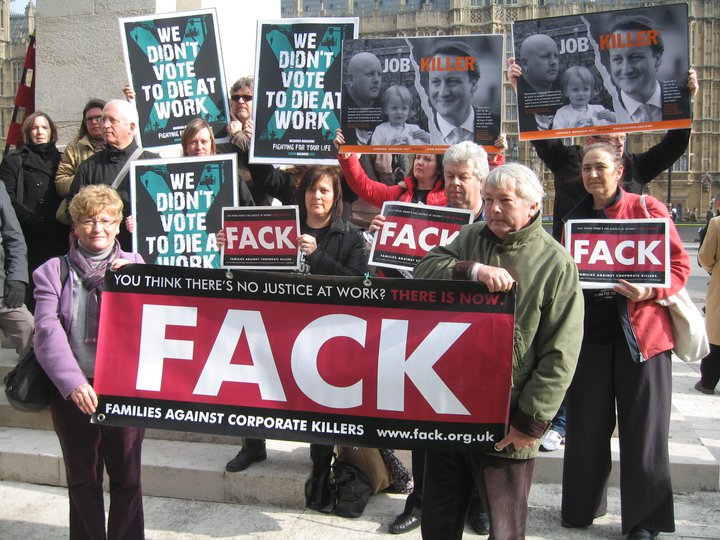
We FACK families are eternally grateful to each and every person who has come together today to mark International Workers’ Memorial Day.  A day when we remember all of those bereaved by work. And renew our commitment to fighting like hell for the living.

Because, just what is it to be bereaved by work…?

It’s to start a day like any other. And end it like no other. To not have known that was your last goodbye. To be left to rue the denial of so many tomorrows and still feel the ripple effects decades on.

It’s to be let down, time and again.  By the employer who had a moral duty and a legal responsibility to look after our family member, and failed in both respects in the worst possible way.  By those politicians who erroneously believe health and safety protections to be burdens on business, and seek to slash and burn where they should be seeking to safeguard and bolster.  By the enforcement authorities who seem so often incapable of effecting proactive preventative inspections.  And by our prosecution bodies, who take far too long to bring negligent employers to, what passes for, justice.

Because, to be bereaved by work is to be a victim of crime.  But to be made to feel like a lesser class of victim.  One where you’re not placed at the heart of the justice process, but left to feel you exist somewhere on the periphery.  To have to garner the strength time and again to face another battle against a justice system, which is meant to be on our side, but which all too often serves to further deepen our trauma.

It’s to question whether you yourself have done enough.  Whether you could have done more to get answers sooner.  To get action quicker. To ensure changes are implemented to prevent the heartbreak of other families like your own. But having to come to terms with the fact this is never within our own power, but reliant on others.  Others who have let us down.

The loss of our loved one’s life set off a chain reaction of change, where the lives we thought we were going to lead are no longer possible.  The wedding day that didn’t happen.  The child who didn’t survive their apprenticeship.  The future mapped out with your partner of 28 years now a solo challenge, rather than a team adventure.  The sibling you can no longer call for advice, or look to for support.

It’s also about facing poverty through the loss of a breadwinner’s income or losing your own job, house, livelihood, as you grieve for your loved one and are unable to work to sustain yourself and your family. Compensation is often not made at all, or is too little, and the benefits system is very harsh and support very scarce. The effects of a work death can resonate painfully through generations.

It’s to feel a devastation you never thought possible.  And other times to feel numb, a nothing-ness, a lack of hope.  When you see another news report of a death due to a so-called “accident” at work, it’s to not just understand what that actually means, but to feel it.

What else is it to be bereaved by work….?

It’s to find lifelong friends you will cherish, all the while wishing you had met in altogether different circumstances.

It’s to find the voice you never knew you had.  The one which, though it may occasionally tremble, steadies itself to assertively speak truth to power. To find that strength you never ever expected to need.

And though you are let down at too many turns, you are lifted by the fortitude and support of others. Like those who work and volunteer in the Hazards movement, Hazards Centres, and charity Scottish Hazards.  Like the trade unionists who help ensure their workplaces are safer and healthier. And like those individual politicians, enforcers, prosecutors and others who do get it, who do understand what we are going through, and who want desperately to bring about the changes we need to see.

We need the employers who do care to guide, educate and cajole those who need woken up to their responsibilities. Laws to be protected. An end to the odious practice of blacklisting. We need enforcement before the fact.  Lessons to be learned, communicated and actioned before loss of life occurs. Penalties that fit the crime. Those bereaved by work to be placed at the heart of the justice system.  And for no other family to have to walk in our families’ shoes.

So, we will continue to tell our loved ones’ stories. We will continue to lay bare our reality.

All in the desperate hope and eternal expectation that we’ll be able to prevent others going through the turmoil of those of us left behind.  Our loved one went to work to make a better life.  Instead, there was loss of life and lives forever altered.

We FACKers pledge to you is to continue to live the International Workers’ Memorial Day mantra each and every day, as we forever remember our dead, and do our damndest to fight like hell for the living.

FACK was established in July 2006, by and for families of people killed by the gross negligence of business employers, to sit with families in the darkest hour and help them speak truth to power, see www.fack.org.uk  https://gmhazards.org.uk/index.php/fack/      Facebook:  Families Against Corporate Killers

Founder Members of FACK:

Dawn and Paul Adams son Samuel Adams aged 6 killed at Trafford Centre,10th October 1998

Linzi Herbertsonhusband Andrew Herbertson 29, killed at work on 30th January 1998

Mike and Lynne Hutin son Andrew Hutin 20, killed at work on 8th Nov 2001

Mick & Bet Murphyson Lewis Murphy 18, killed at work on 21st February 2004

Louise Adamson brother Michael Adamson 26, killed at work on 4th August 2005

Linda Whelanson Craig Whelan 23, (and Paul Wakefield) killed at work on 23rd May 2004

Dorothy & Douglas Wrightson Mark Wright 37, killed at work on 13th April 2005

For more information and to support FACK, contact Hilda Palmer, Facilitator for FACK: Tel 0161 792 1044

c/o GM Hazards Centre/Hazards Campaign, Windrush Millennium Centre,

70 Alexandra Road, Manchester M16 7WD Tel 0161 792 1044

mail@gmhazards.org.uk  www.fack.org.uk https://gmhazards.org.uk/index.php/fack/

Posters, ribbons and more – get your 28 April campaign gear!

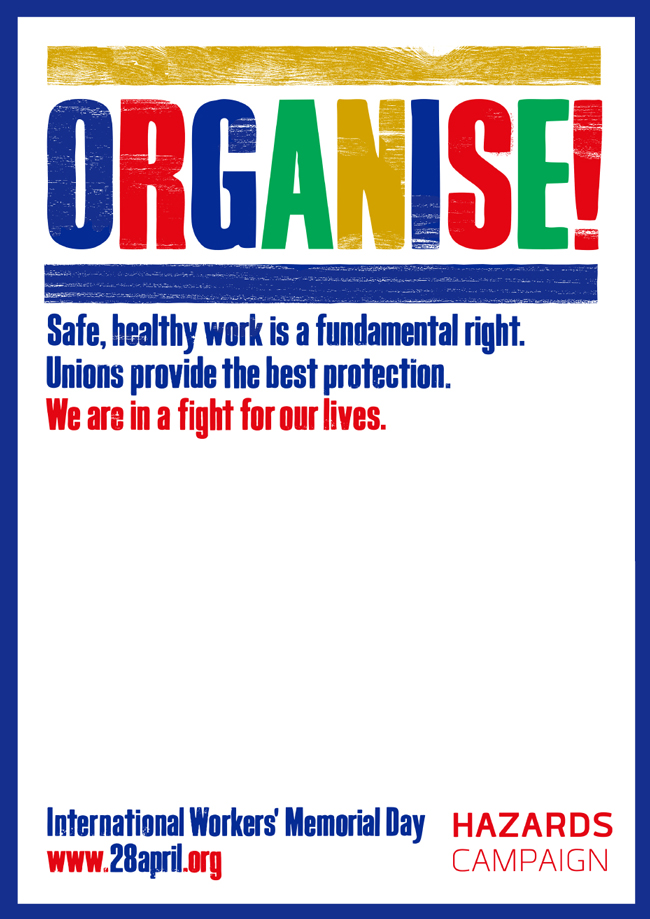
International Workers’ Memorial Day on 28 April 2023 – the biggest event on the trade union safety calendar – is just over a week away. Essential resources, including 28 April purple ribbons, car stickers and ‘Organise!’ posters, bags, t-shirts and hi-vis jackets, are available from the national Hazards Campaign.

RESOURCES
Hazards Campaign 28 April #iwmd23 resources

  • Organise! 28 April posters, specify A4 or A3, free plus cost of postage.
  • Purple ribbons, £50/100.
  • Car stickers, single £1, 2-10 50p each, 11-100 30p each.
  • Bags, £5 plus postage.
  • Organise v-neck t-shirts or Hi-viz gilets (sizes S,M, L, XL), £10.

Contact the campaign for discount rates for larger orders. Further details, email Janet Newsham or phone 07734 317158.

Print off order form.  Return order form to: iwmd23, 177 Watling Street Road, Fulwood, Preston PR28AE.

Cheques made payable to ‘Greater Manchester Hazards Centre Ltd’.

BACS payments
Account Name Greater Manchester Hazards Centre Ltd
Sort Code 60 83 01
Account Number 20090443
Bank Name and address Unity Trust Bank,  Nine Brindley place, Birmingham B1 2 HB.

The HSE needs to be bold, and ambitious on PFAS – Hazards Campaign

Press Release: For immediate release – 5/4/23

The Hazards Campaign welcomes the regulatory management options analysis (RMOA) report from Health and Safety Executive (HSE) on per- and polyfluorinated alkyl substances (PFAS) (1), announced on the 4th April, as a step forward from the unacceptable and alarming situation in the UK.  However, it is predicated on the pretence that the UK can independently make different decisions than the rest of EU or even globally and it not matter.

Janet Newsham, Chair UK Hazards Campaign said: ‘We have a global PFAS crisis.  These ‘forever chemicals’ have seeped into every facet of our environment and human existence.  They are inhaled and absorbed into our bodies and spread via our blood and cause serious and irreversible harm to our health.  Furthermore, they are not restricted by artificial borders, meaning doing something less than the rest of the EU is futile in the fight to arrest the harm.

If as much money was spent tracking and controlling PFAS use, as is spent on supporting industries who are responsible for their production, then we would have known about the dangers long ago.’

The Hazards Campaign’s position is supported by international chemicals policy experts Sara Brosché and Rory O’Neill, both Bureau members for the UN’s Strategic Approach to International Chemicals Management (SAICM).

Dr Sara Brosché, a science adviser with the International Pollutants Elimination Network (IPEN), said:  “It is welcome to see that the HSE recommendations is focusing on regulating broader groups of PFAS, which underscores the urgent need to ban PFAS as a class globally. However, such an effort should rather be based on the recent EU restriction proposal that would see thousands of perfluorinated chemicals severely restricted. These toxic ‘forever chemicals’ are linked to severe health impacts and are already polluting virtually all humans and environments.”

Queen Mary University of London occupational health prof Rory O’Neill agrees.  “The recommendations from HSE are welcome but limited. These are not just ‘forever chemicals’, they are a serious risk to human health, linked to reproductive hazards, cancers and major organ damage. Much more extensive and serious restrictions are warranted.”

Hazards Campaign, Janet Newsham said ‘The UK has decided to disassociate itself from EU REACH with scant consideration to the research, investigations and decisions that are needed on chemical and other toxic substances.  This has meant we have been left with a second rate decision making process.  One that excludes transparency and worker representation at its centre.

The EU proposal to restrict PFAS covers more than 10,000 substances.(4)  For UK workers the HSE RMOA relies on poorly enforced COSHH legislation to protect workers and an HSE that runs scared of regulation.

There are better ways to regulate and control PFAS and other toxic substances.  One suggestion would be to remain part of the EU Reach programme, which has greater resources, trade union and worker scrutiny.  But the political bile of the Brexit lobby makes that unwelcome and unlikely.

As a result, we are left with little scrutiny or influence on the decisions that the HSE make, and an HSE under-resourced and lacking in the essential expertise to make informed decisions, looking for easy solutions that will leave workers in harms way.
The HSE report plays down the cancer risks, which are taken more seriously in the equivalent EU report. [European Chemicals Agency (ECHA) REACH dossier for the universal PFAS restriction on page 30, first para, version 2, 22 March 2023].  (4)

Although the HSE RMOA claims it bases its recommendations on the precautionary principle (page 9)(1), it fails to take a precautionary approach to “probable” carcinogens, and there are currently no Workplace Exposure Limits (WEL) for any PFAS because the analysis takes the view that there is ‘uncertainty with regard to human health hazard profiles of the various groups as well as the use in the workplace.  This seems contradictory to a precautionary approach.’

Whilst we welcome the RMOA, it is clearly too little, toothless and likely to continue to result in workers, our communities and the environment still exposed to PFAS and the health consequences will be dire for many of us.

But it wont end there, we will be exposing our children to continued and increasing exposure to a toxic soup of chemicals: carcinogens, mutagens, endocrine disrupting chemicals and reproductive toxic substances.

The HSE needs to be bold, and ambitious, not weak and ineffective!’

Additional resources:

  1. Press release from the HSE, 4 April 2023: Regulator’s report on “forever chemicals” published
  2. UK NGOs statement on PFAS, published in May 2022 and signed by 35 organisations: Case for urgent, group-based, regulation to prevent continued PFAS pollution in the UK environment
  3. ECHA publishes PFAS restriction proposal April, 2023
  4. ECHA proposal for restriction
Further information:

1.  Hazards Magazine on Chemicals

2.  Eliminating Toxic Substances at Work GMHC website

3.  Hazards Campaign Website

For more information:
Janet Newsham – Chair UK Hazards Campaign
janet@gmhazards.org.uk
07734317158